3 min read

Operationalizing Continuous Assurance Without Slowing the Machine

Operationalizing Continuous Assurance Without Slowing the Machine
5:08

Blog Series: The Death of Static Safety

This is the fourth part of a six-part guest blog series titled "The Death of Static Safety". For today's post, we'll explore how to operationalize continuous assurance without slowing the machine. But first, if you haven't read our first three posts on this overall series, we invite you to do so below. Let's go!

Operationalizing Continuous Assurance Without Slowing the Machine

By now, the problem should be clear. In software-defined machines, safety failures are rare because certification was incorrect. It fails because certified intent is not actively sustained as systems evolve.

Continuous assurance is the answer, but only if it can be operationalized without slowing development, deployment, or operations. That is where most organizations struggle.

Why “More Process” Fails

The instinctive response to assurance drift is procedural: add reviews, add documentation, add approval gates. In software-defined environments, this approach does not scale. When assurance depends on manual controls, teams either slow down delivery or quietly work around the process. Neither outcome improves safety.

What is missing is not rigor, but structure.

Safety Intent Must Become a System Asset

Continuous assurance starts with treating safety intent as something living, not static. The performance bounds (SOTIF) and fault-tolerance requirements (FuSa) must be explicit, traceable, and visible. When software changes behavior, assurance must be reassessed deliberately, not reconstructed after the fact. When safety intent lives only in documents, it cannot be defended at runtime.

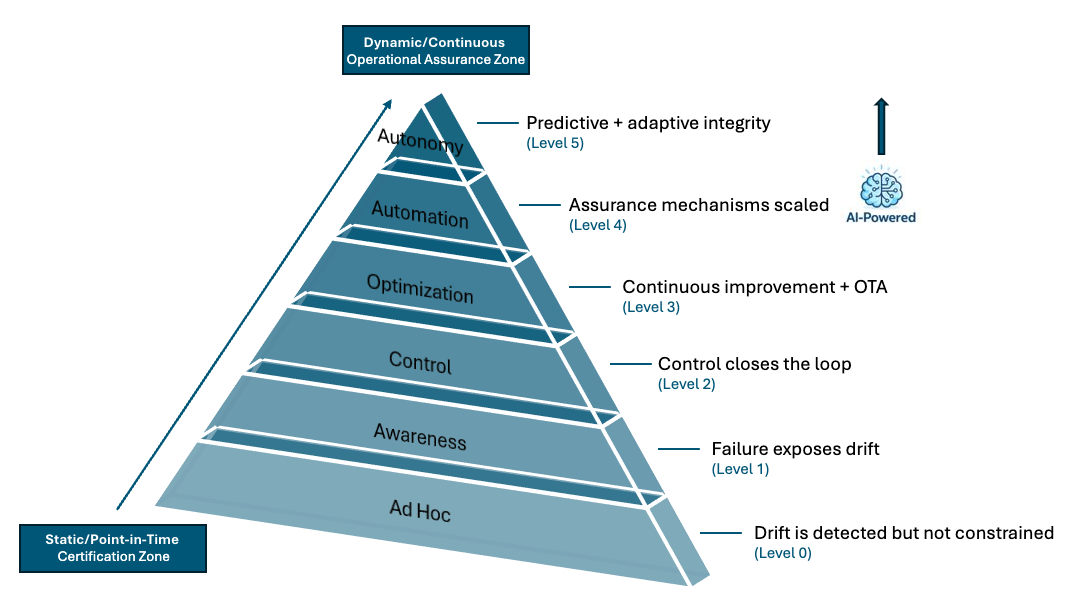
The Maturity Scale defines the transition from reactive safety monitoring to an enterprise-wide culture of continuous vigilance.

The Operating Model Shift

Operationalizing continuous assurance is less about tools and more about how responsibility is distributed. High-performing organizations make safety boundaries clear, define which changes matter, and align product, software, and safety leadership around shared assurance signals.

This clarity reduces friction. Teams move faster when they understand where flexibility exists and where it does not. This structure preserves Freedom from Interference by ensuring that rapid software iterations in non-safety domains cannot silently compromise the enforcement signals.

From Blind Spots to Signals

The most important shift is moving from historical confidence to real-time alignment. The relevant question is no longer whether a system has ever been certified, but whether it is operating in accordance with its certified intent right now.

That requires visibility into a small set of safety-relevant signals, such as:

  • Software or configuration changes that affect certified behavior
  • Interactions between safety logic and autonomy or optimization layers
  • Field modifications that subtly alter operating assumptions
  • Environmental 'Triggering Events' that expose known functional insufficiencies in sensors or algorithms

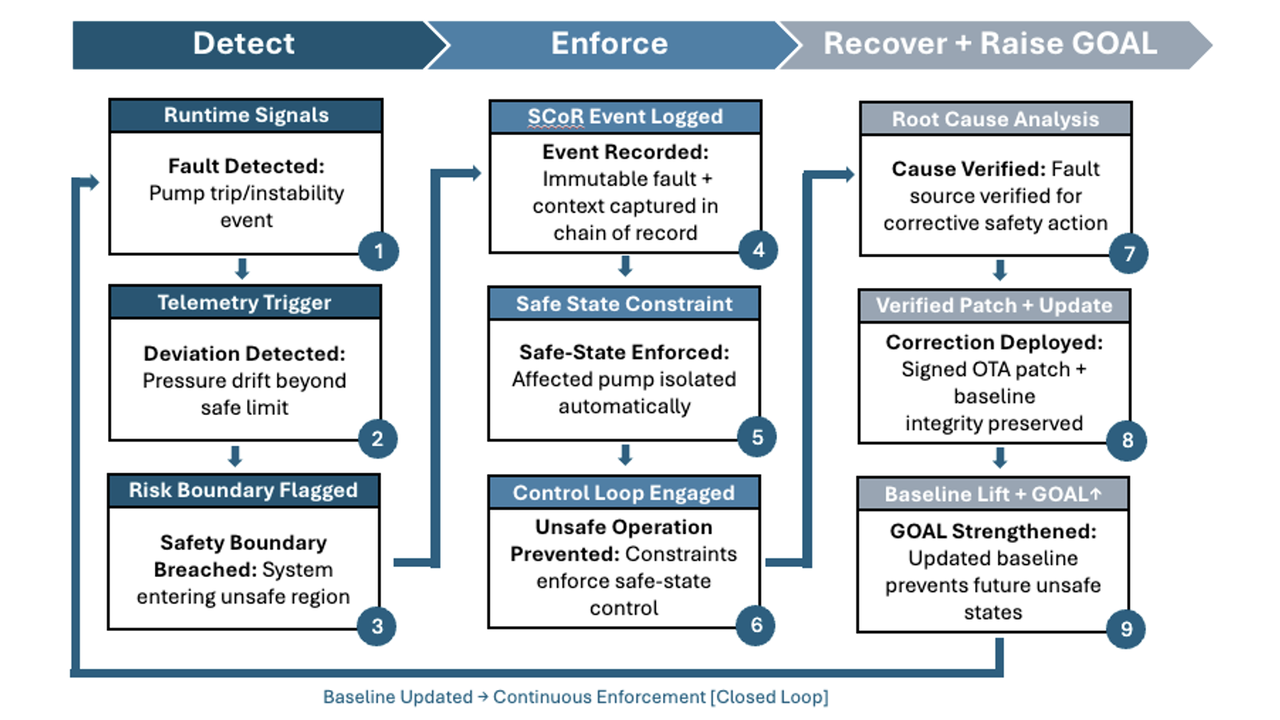
The operational workflow of a closed-loop enforcement system, mapping how runtime data triggers deterministic safety transitions.

This is not about monitoring everything. It is about watching what matters.

Scaling Safety Without Reinventing It

The goal is not to replace functional safety standards, but to make them viable in environments where machines evolve continuously. Organizations that succeed anchor on certified intent, maintain alignment as systems change, and intervene early when drift appears.

Continuous assurance is not a project or an audit. It is an operating capability. When done well, it enables faster, more confident change, clearer accountability, and stronger defensibility in the event of incidents.

The next question is not whether continuous assurance is necessary, but where your organization stands today and how much assurance has already drifted.

That is the conversation that must come next.

About LHP Operational Assurance Systems

LHP Operational Assurance Systems (OAS) was spun out of LHP Engineering Solutions to address a growing gap in safety-critical, software-defined systems: certification at launch no longer guarantees safe operation over time. As complex platforms began receiving continuous software updates and evolving functionality, LHP OAS recognized that traditional "certify-once" models could not prevent runtime drift between validated safety intent and real-world behavior. Drawing on decades of leadership in functional safety, cybersecurity, and systems engineering, LHP OAS was formed to focus exclusively on extending certified intent into live environments and developed a platform, Operational Assurance Sentinel, that embodies this concept. LHP's Operational Assurance Sentinel platform delivers deterministic runtime enforcement, operational assurance scoring, and tamper-evident evidence chains that transform safety from a static milestone into a continuously verifiable discipline, enabling organizations to deploy advanced autonomous and intelligent systems with measurable, provable confidence.

Leave a comment below. We'd love to hear your take on this subject!

Additional Content

Why Safety Certification Assumptions Don’t Survive Reality

Why Safety Certification Assumptions Don’t Survive Reality

Blog Series: The Death of Static Safety This is the first of a six-part guest blog series titled "The Death of Static Safety". We kick things off...

Read More
Avoiding a New Single Point of Failure: Designing Distributed Safety Enforcement

Avoiding a New Single Point of Failure: Designing Distributed Safety Enforcement

Blog Series: The Death of Static Safety This is the third part of a six-part guest blog series titled "The Death of Static Safety". Today, we dive...

Read More
Validating Operational Assurance as a Safety Mechanism

Validating Operational Assurance as a Safety Mechanism

Blog Series: The Death of Static Safety This is the second part of a six-part guest blog series titled "The Death of Static Safety". Today, we dive...

Read More
Construction’s Software-Defined Moment

Construction’s Software-Defined Moment

Construction's Software-Defined Moment This blog was originally posted by Michael Entner-Gómez on his Substack on 2/13/26.

Read More
How the LHP OA Sentinel Platform Embeds Trust Into Every Mile

How the LHP OA Sentinel Platform Embeds Trust Into Every Mile

How the LHP OA Sentinel Platform Embeds Operational Trust The automotive industry keeps confusing precision with control. Every major OEM has built...

Read More
Why Operational Assurance Matters?

Why Operational Assurance Matters?

Operational Assurance: The Discipline for the Age of Systems of Systems From Isolation to Interconnection In the past, managing complex environments...

Read More